Innovation Methods
Browse our curated collection of proven innovation methods to solve your business challenges.

1000 True Fans
A creator-economy strategy — originated by Kevin Kelly in 2008 — that argues you only need roughly 1,000 deeply committed fans, each spending about $100 per year, to build a sustainable independent living.

A/B Testing
Run controlled experiments comparing two versions of something to find out which one actually performs better - with data, not opinions.

Accelerator Program
Transform promising early-stage ventures into investment-ready companies through an intensive, time-bound program combining seed funding, expert mentorship, structured curriculum, and a powerful network culminating in a high-stakes Demo Day.

Acceptance Criteria
The specific, testable conditions that define when a user story is complete - eliminating the "I thought you meant..." conversations that derail sprint reviews.

Brainstorming
A creative group ideation technique designed to generate a large quantity of diverse solutions to well-defined challenges.

Build-Measure-Learn
Build-Measure-Learn is the core feedback loop of the Lean Startup methodology, developed by Eric Ries - a disciplined cycle where teams build the smallest possible testable version of an idea, measure real customer response with actual data, and learn whether their assumptions were correct before deciding to persist, pivot, or stop.

Building Your Flywheel
Building Your Flywheel is a strategic framework for identifying and strengthening the self-reinforcing growth loops that give your business compounding momentum - where each turn of the cycle makes the next turn faster and harder for competitors to match.

Building in Public
A transparency-driven development approach where you openly share your product journey, inviting customers to co-create solutions through real-time feedback, public roadmaps, and visible decision-making.
Business Model Canvas
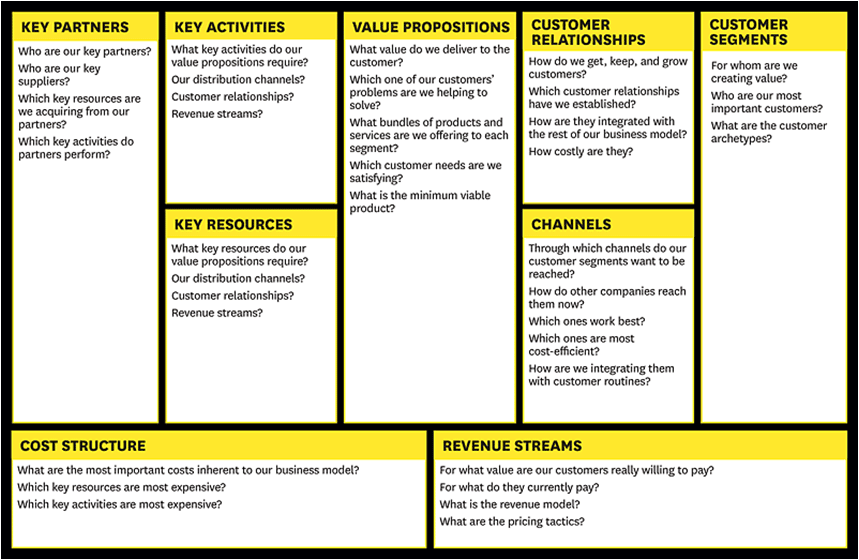
All the substance of a business plan without the months of writing, with 9 essential elements that transform customer needs into money-making ventures.

Business Model Economics
The goal of articulating your high-level Economic Logic is to show sponsors and funders that you understand what drives growth and profitability.

Business Model Snapshot
A Business Model is your strategy for delivering value to - and capturing value from your customers.

Challenge Brief
A successful innovation begins with a great challenge - it can be a problem or an opportunity.

Competitive Position
A strategic assessment tool that helps teams differentiate their offerings from competitors by focusing on the two priorities customers care about most.

Consumer Trend Canvas
A strategic framework that transforms consumer trends into actionable innovation opportunities by systematically analyzing underlying human needs, change drivers, and emerging expectations.

Crowdsourcing
A distributed innovation approach that taps into the collective intelligence of large external groups to solve problems, generate ideas, and create value that internal teams alone could never achieve.

Customer Acquisition
A strategic method for identifying and addressing the bottlenecks that could limit your ability to grow your customer base at scale.

Customer Journey Map
A visual storytelling technique that maps out each step of a customer's experience with your product or service, capturing both actions and emotions along the way.

DFV Matrix
A structured prioritization framework for evaluating product concepts, features, or business ideas against three critical dimensions: user Desirability, technical Feasibility, and business Viability.

Design Principles
A collaborative workshop method for establishing clear, actionable design guidelines that align teams and shape consistent product decisions across your organization.

Design Sprint
A five-day process for solving problems and testing new ideas through design, prototyping, and testing with customers.

Development Sprints
Fixed time-boxed cycles where a development team builds and ships a defined increment of the product - creating a predictable rhythm of planning, building, and learning.

Facts, Assumptions and Doubts
A focused workshop format that separates what your team knows for certain, what they believe to be true, and what questions remain unanswered before diving into product development.

Four Steps to the Epiphany
Four Steps to the Epiphany gives startups a systematic methodology for searching - not executing - their way to a repeatable, scalable business model by putting customer discovery and validation before product development and scale.

Futures Thinking
A systematic approach to exploring multiple plausible futures that helps organizations anticipate change, challenge assumptions, and make more resilient strategic decisions through Open Innovation ecosystems.

Hackathons
A time-boxed innovation sprint where cross-functional teams rapidly prototype solutions to specific challenges, transforming ideas into working demos in 24-48 hours.

Hamburger Insight Gathering
A playful prioritization workshop that uses a hamburger metaphor to help teams categorize and prioritize insights, issues, and objectives into actionable layers.

How Might We...?
A powerful question-framing technique that transforms research insights into opportunity spaces, setting the stage for innovative solution brainstorming.

Innovation Mapping
Transform overwhelming innovation landscapes into strategic clarity by using data science, network analysis, and visualization to map actors, ideas, and trends - revealing hidden gaps and collaboration opportunities that others miss.

Jobs to Be Done
Jobs to Be Done reframes product strategy around the underlying progress customers are trying to make in their lives - not their demographics or feature preferences - delivering a far more durable explanation of why products succeed or fail, and where real innovation opportunity lives.

Kanban Boards
A visual system for managing work in progress - limit what's active, see where things are stuck, and finish more by starting less.

Key Performance Indicators
Transform opinions into evidence by identifying the metrics that actually matter for your product and business decisions.

Lean Canvas
A one-page business model template designed specifically for new product concepts, focusing on customer problems and solutions delivered through a unique value proposition.

Lightning Demo
A rapid-fire inspiration session where team members share examples of products, services, and experiences they admire to spark creative solutions for design challenges.

MVP Specification
A strategic approach to defining the minimal feature set needed to deliver value to customers, test market assumptions, and validate business potential with minimal investment.

Mind Mapping
Mind mapping is a visual thinking tool that externalises the brain's natural associative patterns — turning complex topics, sprawling plans, and tangled ideas into radiant, navigable diagrams that make structure visible and connections obvious.

MoSCoW Prioritization
MoSCoW Prioritization is a clear, collaborative framework for sorting requirements into four buckets - Must Have, Should Have, Could Have, and Won't Have - that gives teams and stakeholders a shared language for making difficult trade-off decisions under time and resource constraints.

North Star Metric
One powerful metric that captures the core value your product delivers to customers, aligning your entire organization around sustainable growth that benefits both users and business.

One Metric That Matters
A laser-focused growth framework that identifies the single most important metric for your startup right now, cutting through data noise to drive meaningful progress at your current stage.

Pilot Canvas
The Pilot Canvas is a 1-page planning tool specifically designed to help you define and plan your pilot.

Pirate Metrics (AARRR)
A five-stage growth framework that tracks your customer lifecycle from first contact to loyal advocate, helping you find exactly where users drop off and how to fix it.

Pivot or Persevere
The Pivot or Persevere meeting is a structured decision-making ritual from Lean Startup methodology that uses validated learning data - not gut instinct or sunk cost reasoning - to answer the most consequential question any startup faces: should we fundamentally change direction, or stay the course with greater conviction?

Problem Interview
A structured customer discovery technique to validate problem hypotheses, understand existing solutions, and identify early adopters before committing to building a specific solution.

Problem Reframing
Properly framing the innovation challenge is critical to your success.

Product Owner
The Scrum role responsible for maximizing product value - owning the backlog, making prioritization decisions, and bridging the gap between business needs and the development team.

Product Requirements Document
A Product Requirements Document (PRD) defines what a product must do, for whom, and why - creating the shared contract between product, engineering, and design that prevents misaligned execution and ensures development effort is directed at the right outcomes.

Product Roadmap
A strategic planning tool that maps out how your product will evolve over time, from dominating your initial market to expanding into new territories.

Product/Market Fit
Product/Market Fit is the critical milestone where a product satisfies strong, genuine market demand - evidenced by organic growth, high retention, and customers who would be truly disappointed if the product disappeared - and represents the single most important threshold any startup must cross before it is ready to scale.

Prototype Test Plan
Test each of the individual key assumptions and the envisaged value propositions.

Prototyping
A hands-on technique for rapidly bringing ideas to life in a tangible form that can be tested with real users to validate assumptions before significant investment.

Public and Social Innovation Labs
A structured approach for governments and civic organizations to tackle complex social challenges by bringing together citizens, public servants, and experts in collaborative experimentation spaces.

Rapid Ideation
Rapid Ideation is a time-boxed brainstorming technique where participants generate as many ideas as possible in a short, focused burst - typically 5 to 10 minutes - prioritising quantity over quality to break creative blocks, bypass self-censorship, and surface unexpected solutions that slower, more deliberate thinking rarely reaches.

Rapid Prototyping
Rapid prototyping compresses the distance between idea and insight by building quick, low-fidelity representations of a product or feature and putting them in front of real users within hours or days - learning fast, failing cheap, and iterating before significant resources are committed.

Research Plan
Every challenge is different, so take some time to develop and execute a research plan that's custom made to deeply understand your challenge.

Reverse Ideation
A creative thinking technique that generates breakthrough solutions by deliberately exploring ways to make a problem worse, then reversing those insights into actionable fixes.

SCAMPER
SCAMPER is a structured creative thinking checklist that turns seven simple questions into a systematic engine for generating breakthrough product, service, and process ideas.

Scaling Operations
Map the end-to-end value chain and asses what's required to scale.

Scaling Playbook
A systematic approach for transitioning from innovation mode to execution mode, building the critical systems needed to grow from startup to sustainable business.

Site Maps
A site map is the architectural blueprint of a digital product — a hierarchical diagram that makes information structure visible, reveals navigation logic, and exposes gaps and redundancies before a single screen is designed or a line of code is written.

Solution Interview
A solution interview is a form of a customer interview to test if you are on the right path.

Storyboarding
A visual storytelling technique that uses a sequence of images to illustrate how a user would interact with your solution in a specific scenario.

Surface Assumptions
A systematic approach for identifying and prioritizing the critical assumptions underlying your product concept before testing with real users.

Technology Readiness Levels (TRLs)
A nine-level assessment framework — originally developed by NASA — that measures how ready a technology is for prime time, from basic research all the way to proven deployment.

Test Plan
A Test Plan is a formal document that specifies the scope, strategy, resources, and schedule for testing a software system or product feature - ensuring that quality goals are defined and systematically pursued before release, not discovered through customer complaints after it.

Total Addressable Market
A method for estimating the total revenue potential for your solution if you captured the entire target market, helping you determine if an opportunity is worth pursuing.

Total Addressable Problem
Total Addressable Problem is a reframing, and asks teams to focus on creating new markets - on what's possible.

Usability Testing
Usability Testing is a user research technique where real users attempt to complete specific tasks on a product while researchers observe, listen, and record difficulties - revealing usability problems, confusion points, and opportunities to improve the user experience before those problems cost the organisation customers, revenue, or reputation.

User Personas
A method for creating realistic representations of your key user types that capture their goals, behaviors, and pain points to guide product decisions.

Value Prop Scorecard
A technique for transforming vague benefits into concrete, measurable value that clearly demonstrates the impact of your solution on customer priorities.

Value Proposition Canvas
A structured framework for aligning your product or service offerings with specific customer needs, ensuring you create value that matters to your target audience.

Vision GROW
A structured workshop format that aligns teams around an aspirational vision while creating a clear, actionable first step toward making it reality.